Exchange, Hot or Cold Wallet: Where Should a Player Keep Crypto?
Exchange, hot wallet or cold wallet: three places to keep crypto from a player's point of view, with the FTX and Bybit stories and a simple three-pocket plan.
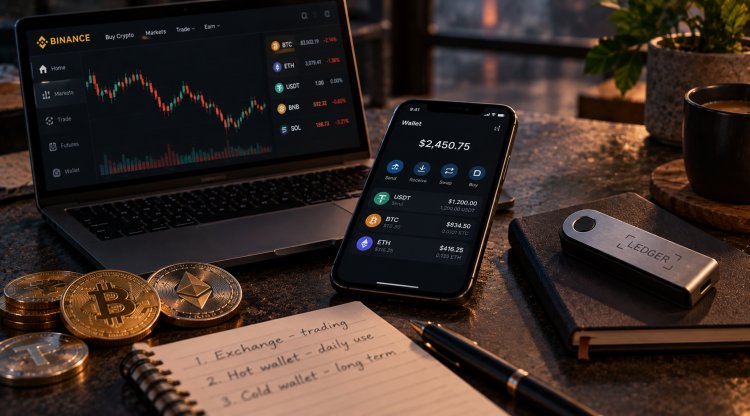
Everyone who plays with crypto sooner or later asks the same question: where is this money supposed to live while I'm not playing? Leave it on an exchange? Move it to a wallet on my phone? Buy that hundred-dollar USB stick everyone keeps talking about?
To make it easier, meet three characters. Each has a personality, strengths and a few skeletons in the closet.
Character one: the Exchange, your friendly neighbor
An exchange is like a neighbor who kindly offered to keep your house keys at his place. Handy: lose yours, just pop over. Buying, selling, swapping and sending to the casino takes a couple of clicks, and the password can be reset by email.
The catch is that he's the one holding the keys. Crypto has a saying for this: "Not your keys, not your coins." While your crypto sits on an exchange, what you actually own is the exchange's promise to give it back.
Usually that promise is kept. But not always. In November 2022, FTX, one of the biggest exchanges in the world, halted withdrawals on November 8 and filed for bankruptcy on the 11th. Customer balances turned out to have a hole of around $8 billion. People who were simply holding coins there "for better times" waited years for repayments.
Good for: people who buy and sell often and only keep on the exchange what they need right now.
Character two: the Hot Wallet, the wallet in your back pocket
A hot wallet is an app on your phone or a browser extension connected to the internet. Like a wallet in your back pocket: always with you, out in a second, and you're the only one with the keys.
When you create it, the wallet gives you a seed phrase, usually 12 or 24 words. That is your key. Whoever knows the phrase owns the money. No support team can recover it, because there is no support team.
The downside is obvious too: a back-pocket wallet can be pickpocketed. If your phone is infected, or you type your seed phrase into a phishing site or approve a suspicious transaction, the money is gone. We covered what to do in that case in What to Do If Your Crypto Wallet Gets Hacked.
Good for: "working" money that's about to go into play or be spent.
Character three: the Cold Wallet, the safe at the country house
A cold wallet is a separate device, a bit like a USB stick, that keeps your keys offline. To send coins you have to plug it in and physically press a confirmation button. Like a safe at a country house: very secure, but you'll have to drive out to get your money.
Malware on your computer can't reach the keys, because they never leave the device. But there's a catch here too, and it matters. In February 2025, around $1.5 billion in ether was stolen from the exchange Bybit, and it was taken from a cold wallet. The hackers tampered with the interface staff used to approve transfers: the screen showed one thing, but they were signing something else entirely.
The moral is simple: a safe protects you from pickpockets, not from someone who talks you into opening it yourself. Before you press "confirm" on the device, read the address and amount on its own screen.
Good for: savings you don't plan to touch for weeks or months.
The showdown
| Exchange | Hot wallet | Cold wallet | |
|---|---|---|---|
| Whose keys | the exchange's | yours | yours |
| Convenience | maximum | high | you need the device |
| Main risk | exchange bankruptcy or hack | malware and phishing | lost seed phrase, tampered transaction |
| Forgot your password | support will help | only the seed phrase helps | only the seed phrase helps |
| Cost | free | free | the device itself |
A plan for players: three pockets
There's no perfect place, so experienced players spread their money across three "pockets".
- The evening pocket. Only what you're willing to spend on playing today. It sits on your casino balance.
- The weekly pocket. A reserve for upcoming deposits. It lives in a hot wallet, one transfer away from the casino. Ideally in stablecoins, and we explained why in our piece on the Fed and bitcoin.
- The long-term pocket. Everything you're saving and don't intend to gamble. It belongs in a cold wallet, far from the temptation to "top up a bit more".
The plan has a nice side effect. When reaching your savings means getting out a device and pressing a button, impulsive "one last bets" become a lot less frequent.
Five rules for your seed phrase
- Write it on paper or a metal plate, not in phone notes or the cloud.
- Never take a photo of it.
- Keep it in two places, so a fire or flood can't take everything at once.
- Never tell anyone. Not "support", not "a friend from chat", not a casino employee. Real staff never need it.
- If someone asks for your seed phrase, they're a scammer. No exceptions.
Instead of a conclusion
An exchange is convenient, but the money on it isn't quite yours. A hot wallet is yours, but it lives in a rough neighborhood. A cold one is secure, but even it won't save you if you sign the wrong thing. So the best answer to "where should I keep crypto" is: a little bit everywhere, with each pocket doing its own job.
If you're just starting out, first read how a crypto wallet works, then our guide on which crypto to deposit and withdraw with. Once your wallet is ready, you can top up right on Coins.Game.
What's Your Reaction?