$42 Million on Screen, $2.25 at the Cashier: Three Jackpot Court Cases
A slot showed $42.9 million and the casino offered a steak. Three famous jackpot court cases: who won, who lost and what to do if your win is disputed.
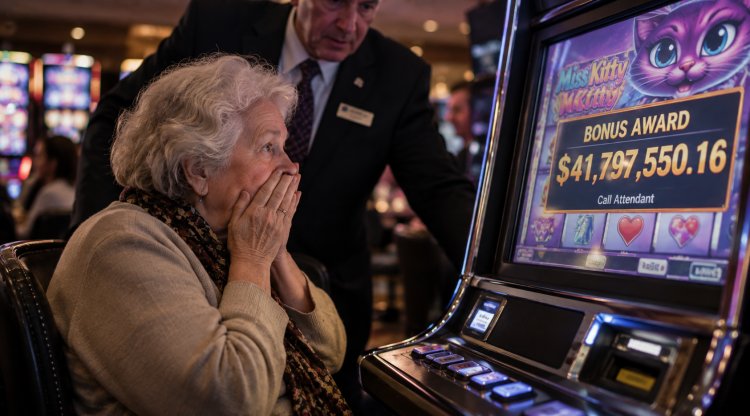
Every player has the same dream: the screen lights up, the machine rings, a multimillion figure flashes on the display. For some people that dream came true. And then the floor manager walked over and said the magic words: "technical malfunction".
We've gathered three real court cases over jackpots. In two, the casino won. In one, the player did. And each one has a lesson worth knowing for anyone who plays.
Case #1. Grandma and $41.8 million
Where and when: 2011, Isle Casino in Waterloo, Iowa.
Amount on screen: $41,797,550.16.
What she got: $1.85.
87-year-old Pauline McKee was playing a Miss Kitty penny slot. The reels stopped on a combination worth 185 credits, or $1.85. Then a message popped up: "Bonus Award: $41,797,550.16."
The casino called it a computer glitch and refused to pay. McKee sued for breach of contract and consumer fraud. The case went all the way to the Iowa Supreme Court, which sided with the casino on April 24, 2015. The court's logic: the game rules are the contract between player and casino. Under those rules the maximum win was capped at $10,000 and the game had no bonus at all. So the player was entitled only to what actually landed on the reels. That is, $1.85.
Case #2. A steak instead of $42.9 million
Where and when: August 2016, Resorts World Casino in Queens, New York.
Amount on screen: $42,949,672.76.
What she was offered: $2.25 and a free steak dinner.
Katrina Bookman, a mother of four, was playing a Sphinx slot. The screen showed almost $43 million, and she even managed to take a selfie with it. The next day she was told the machine had malfunctioned and that she had actually won $2.25. As a consolation, she was offered a steak.
The New York State Gaming Commission confirmed it was a display malfunction, and the machine carried the notice "Malfunctions void all pays and plays". On top of that, the machine's maximum payout was $6,500.
A fun detail for math fans: the amount on screen is suspiciously close to 2 to the power of 32 cents, which is $42,949,672.96. It looks like a classic counter overflow in the software. Similar "$42.9 million" displays have popped up at other casinos too, in Canada and Colorado.
Bookman sued the casino and the machine's maker. Her lawyer asked for at least the $6,500 maximum. The case dragged on for years, and according to Casino.org, the court ultimately sided with the casino.
Case #3. Player vs bookmaker, and the player won
Where and when: January 2018, online, United Kingdom.
Amount: £1,722,500.24.
Outcome: paid in full, with interest.
Andrew Green from Lincolnshire was playing the online blackjack game Frankie Dettori's Magic Seven on Betfred from his phone and won more than £1.7 million. The win showed up in the game. Then Betfred said the game had a software glitch that made it pay out more than it should and froze the payment.
First Green was offered £30,000 "as a goodwill gesture", on condition that he kept quiet about the story. Then £60,000. He turned down both and went to the High Court. In April 2021, Mrs Justice Foster ruled that the clauses in Betfred's terms were too vague to release the company from paying out on an ostensibly winning bet. Betfred paid the full amount with interest and costs and did not appeal.
Why the rulings differ
At first glance the courts seem to contradict each other, but the logic is the same. The game rules are treated as a contract, and the court looks at exactly what they say.
- McKee and Bookman lost because the amount on screen didn't match the rules: it exceeded the maximum possible payout, and the reels only paid cents.
- Green won because his bets looked like winning bets under the game rules, and the malfunction clause was too general to take the win back after the fact.
The key takeaway: in jackpot disputes, the winner isn't whoever shouts loudest, but whoever has the rules and the evidence on their side.
What to do if your win is disputed
- Record everything. Photos and video of the screen, the time, the machine number or the round ID in an online game. Bookman's selfie wasn't for nothing.
- Don't walk away or keep playing that machine until a staff member arrives.
- Ask for a written explanation of the refusal and keep the correspondence.
- Read the game rules, especially the maximum win and the malfunction clause.
- Don't rush to accept "hush money". Green turned down £60,000 and got almost 29 times more.
- Contact the regulator that licensed the casino, and a lawyer if the amount is serious.
The moral
A huge number on the screen isn't a win yet, and the word "malfunction" isn't a final verdict. Rules and evidence decide. That's why transparency matters so much: at online casinos with provably fair technology, like the crash games at Coins.Game, you can verify every round yourself, so disputes are far rarer. We explained how it works in AI in Casinos: What Algorithms Can Do and What's a Myth.
If your problem is a regular deposit rather than a jackpot, read our story about a "missing" deposit. And for the opposite case, where the casino pays the loser, see the Bad Beat Jackpot.
What's Your Reaction?