Why Does a Casino Want Your Face? KYC and Deepfakes, Minus the Paranoia
Why casinos ask for your ID and a selfie with a note, what KYC is, how fraudsters fake faces with AI, and which of it actually affects you as a player.
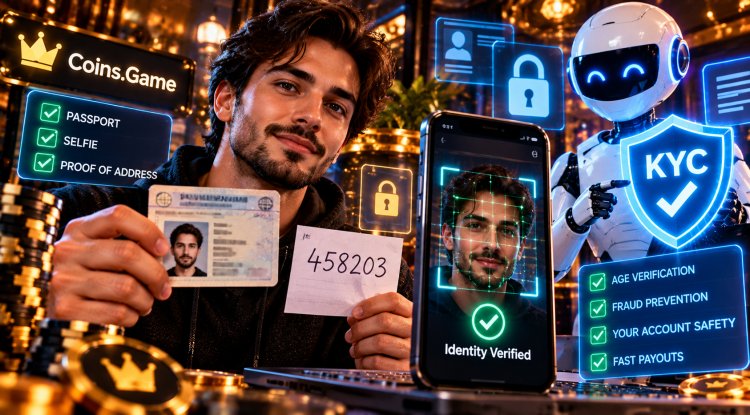
You know the scene. You win, hit "Withdraw", and the casino replies: "Please send a photo of your ID. And a selfie. And a note with some numbers next to it." First thought: this is a scam. Second thought: why do they even need my face?
Relax. Below we go through the most popular myths about verification and explain where face-faking neural networks come into it.
"The casino is just looking for an excuse not to pay"
Not quite. Verification is called KYC, short for Know Your Customer. It's a requirement of anti-money laundering laws, and a licensed casino has to do it whether it wants to or not.
The goal is simple: make sure the account owner is the one withdrawing, that they're over 18 and that dirty money isn't being run through the casino. If a casino paid out to anyone, any amount, fraudsters would be first in line, and the victims would be honest players whose accounts got hijacked.
"They'll want everything at once"
Usually not. Many casinos verify players in stages: the bigger the amounts, the deeper the check. Here's how Coins.Game sets it out in its AML policy:
| Step | When it's needed | What you'll be asked for |
|---|---|---|
| One | for any withdrawal | a form: first and last name, date of birth, country of residence, gender, address |
| Two | deposits or withdrawals over $2,000 | a photo of your ID next to a note with a random six-digit number, plus a data check against two databases |
| Three | deposits or withdrawals over $5,000, or sending another player over $3,000 | proof of source of funds |
Until the required step is done, the withdrawal, transfer or deposit for that amount is put on hold. So if you play small, a form is all it takes.
"What's with the note with numbers? Is this some kind of quest?"
It's the smartest part of the process. Under Coins.Game's rules, you hold a note with random numbers generated by the system next to your ID, and send a separate photo of your face.
The point is that an old ID photo from the internet or someone's leaked scan won't match those numbers. The note can't be prepared in advance; it has to be written right here, right now. A plain sheet of paper cuts off a whole class of fakes.
"Deepfakes are science fiction, it won't happen to me"
Fraudsters would love you to think so. In reality, AI face-faking has become a working tool. According to identity verification company Sumsub, deepfake fraud cases worldwide grew by 700% from Q1 2024 to Q1 2025.
The gambling industry is on the front line. In the same Sumsub research (June 2025):
- 82.9% of iGaming operators said fraud had increased over the year;
- 78% saw a rise in AI-generated documents;
- the top threats were identity fraud (64.8%), money laundering (64.8%) and bonus abuse (63.8%).
The authors also singled out Brazil: in Q1 2025, deepfake fraud there was five times as common as in the US.
For you, this means one thing: strict verification protects your account too. If someone steals your documents or makes a deepfake of your face, this check is what stops them from withdrawing your money.
"I'll hand over my ID and my data will leak"
Any service that holds your documents carries some leak risk, whether it's a bank, an airline or an online store. But there's something you can do yourself. Coins.Game's rules state plainly that on your ID photo you may cover everything except your date of birth, nationality, gender, first and last name and the photo itself. Document number, registered address and the rest can be blurred.
And the key rule: only send documents through the site itself, in your account settings. If someone messages you on Telegram or by email as the "casino security team" asking for your passport, it's a scam.
How to pass on the first try
- Shoot in good light, with no glare on the document.
- All four corners of the document must be in the frame and the text must be readable.
- If proof of address is needed, a recent utility bill, bank statement or government document issued within the last three months will do.
- The details in your form must match the document letter for letter.
- If you plan to withdraw large sums, it's easier to get verified in advance rather than at the moment of a big win.
So does a casino need your face?
Yes, but not for a collection. Your face and a note with numbers are simple proof that a living person stands behind the account, not a neural network, a bot or a hijacker. In a world where a fake video can be made in an evening, that's actually good news for players.
To see where else algorithms work in casinos and why Aviator "predictors" are still a scam, read AI in Casinos: What Algorithms Can Do and What's a Myth. Tips on withdrawing your winnings calmly are in our guide to safe withdrawals. The full verification rules are in the AML section on Coins.Game.
What's Your Reaction?