Short Deck (6+): 8 Tips for Beginners
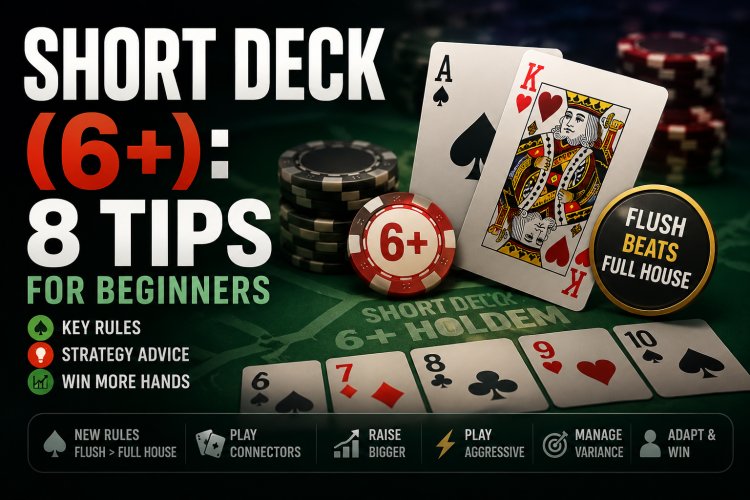
In recent years, the short-deck version of Texas Hold’em played with a 36-card deck has become increasingly popular. In this guide, we’ll explain the key differences between Short Deck and traditional Hold’em, and give you several tips to help you get started confidently in this format♠️
If you don't want to read the text, you can watch a short video
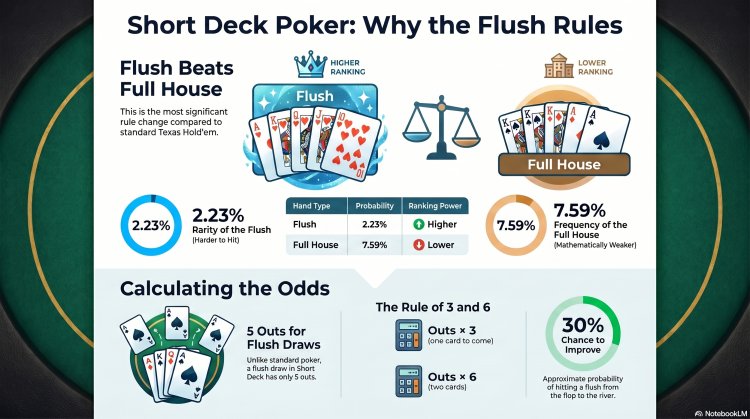
Flush Beats Full House
This is the biggest rule change compared to regular Texas Hold’em.
The reason is simple: in a short deck, making a flush is actually harder than making a full house.
The probability of hitting a flush is around 2.23%, while a full house appears about 7.59% of the time.
That means if you make a full house, you shouldn’t automatically assume you’re unbeatable. If the board contains two suited cards, you still need to worry about flushes and protect your hand by denying proper odds to drawing hands.
A flush draw in Short Deck has 5 outs. On the flop, that means roughly a 30% chance to improve by the river, and around 15% on the turn. The exact math differs slightly, but for quick calculations you can use a simple formula:
-
multiply your outs by 3 with one card to come,
-
and by 6 with two cards to come.
Pocket Pairs Are Weaker
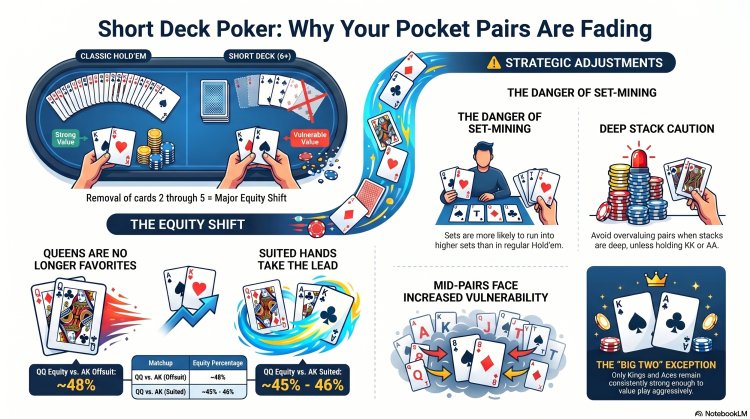
In classic Hold’em, pocket pairs are usually slight favorites against two overcards. In Short Deck, that changes dramatically.
For example:
-
QQ vs AK offsuit = about 48% equity for queens.
-
Against suited AK, queens drop to around 45–46%.
Lower pairs perform even worse.
Hands like 88, which are fairly solid in regular Hold’em, become vulnerable not only to overcards but also to higher two-pair combinations, since the deck only contains cards from 6 to Ace.
Even set-mining becomes more dangerous. A set of eights can easily run into a higher set far more often than in regular Hold’em.
The advice is simple:
don’t overvalue pocket pairs unless they’re KK or AA, especially when stacks are still deep.
Straight Draws Are Monsters
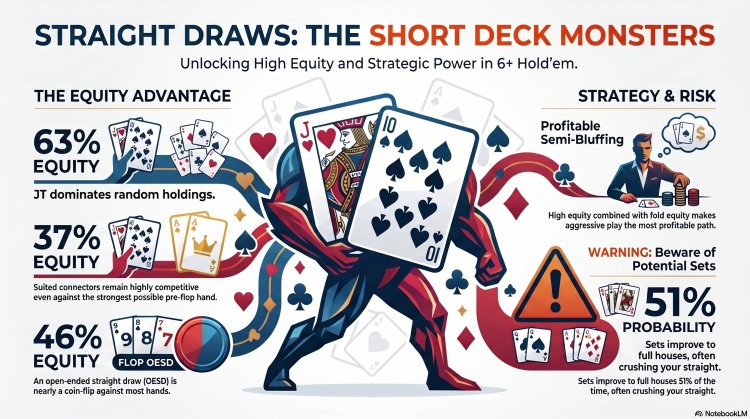
Hands like JT or QJ gain massive value in 6+ Hold’em.
JT against a random hand has around 63% equity. Even against pocket aces, suited connectors can still have roughly 37%.
An open-ended straight draw on the flop has approximately 46% equity — excellent for semi-bluffing.
Since aggressive players also generate fold equity, strong straight draws become highly profitable to play aggressively.
However, be careful against possible sets. In Short Deck, sets improve to full houses very often — roughly 51% by the river — which can crush your straight.
Weak Aces Are Even More Dangerous
At reasonably competent tables, hands like A9 and weaker are usually folds preflop.
Even if you flop an ace, you’ll rarely feel comfortable. Opponents frequently hold stronger aces, sets, or strong draws, while your own hand has limited improvement potential.
And even when your opponent doesn’t have an ace, they still have plenty of equity against one pair because straights and sets happen so often.
Another issue:
if you are ahead, weaker hands rarely pay you off. In Short Deck, players almost never continue with second pair or worse.
Preflop Raises Must Be Bigger
Short Deck also changes the blind structure.
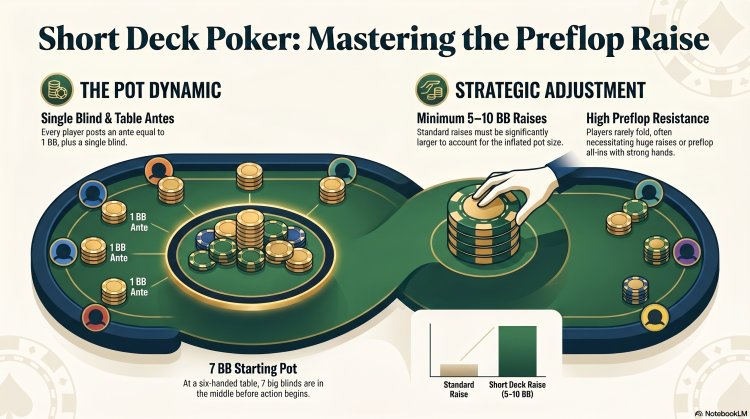
Instead of small blind and big blind, one player posts a single blind while everyone at the table posts an ante equal to 1 BB.
That creates a large pot immediately.
At a six-handed table, there are already 7 BB in the middle before the action even starts.
As a result, standard raises need to be much larger:
-
usually at least 5–6 BB,
-
sometimes even 10 BB.
Many players refuse to fold preflop in this format, so strong hands often require huge raises or even all-ins.
Extremely Aggressive Gameplay
Try not to limp.
It’s already questionable in regular Hold’em; in Short Deck it’s often disastrous.
You’ll constantly face:
-
preflop all-ins,
-
flop overbets,
-
aggressive semi-bluffs with draws.
Always remember:
even top two pair isn’t necessarily strong enough to stack off.
Big hands happen constantly in Short Deck, and two pair is far from the nuts.
Brutal Variance
The amount of bad beats and coolers in this game can shock even experienced poker players.
Since almost any two cards retain decent equity, suckouts happen all the time.
If you want to play Short Deck seriously, you need strong mental discipline and the ability to survive endless bad beats without tilting.
That’s simply part of the format.
Tons of Gamblers
The upside of this massive variance is that Short Deck attracts many gambling-oriented players.
People are happy to shove entire stacks with hands like JT or 99.
That gives you opportunities to double up much more often with premium hands like AK.
Unlike regular Hold’em, where all-ins often force folds, players in Short Deck call much wider — and you’re usually still a slight favorite.
Be prepared to shove aggressively with strong holdings.
Still, in this format there are really only three truly premium hands:
-
AA
-
KK
-
AK
Everything else is highly situational.
As mentioned earlier, even hands like QQ and JJ are far from automatic all-ins.
Of course, like every poker variant, Short Deck contains countless subtleties that only come with experience.
Over time, you’ll learn how to adjust to different table dynamics and player types. But for now, these fundamentals should help you survive the endless storm of raises and reraises that defines 6+ Hold’em.
What's Your Reaction?