10 Tips for Beginners in Tournament Poker
In this post, we’ll cover macro-level strategy for online poker tournaments. Whether you play Texas Hold'em, Omaha Hold'em, Short Deck, or another poker format, these tips will help you make effective decisions at every stage of a tournament — even if you’re completely new to poker.

-
Bankroll Management
Bankroll management is essential for confidence. If you’re playing with your last money, one thought stays in your head the entire time: “I just can’t bust.” That mindset seriously hurts your game, making you overly cautious and causing you to miss opportunities to win big pots.
For most players, the optimal bankroll is around 100–150 buy-ins. One hundred is usually enough if you rarely rebuy after busting. If you use rebuys frequently, it’s safer to keep around 150 buy-ins.
Example: if you want to play $5 tournaments, your bankroll should be at least $500 — ideally $750. As a beginner, you probably won’t start winning immediately. Having enough money behind you prevents tilt when you inevitably lose 10–15 tournaments in a row. That happens to every tournament player.
-
Choosing the Right Tournament
At first, it’s better to focus on one game. For example, let’s use Texas Hold'em in this article, although these strategic principles also apply to Omaha, Omaha Hi-Lo, and Short Deck.
Over time, you’ll figure out which format suits you best and can specialize if maximizing profit matters more than variety. Some players thrive in long, methodical tournaments. Others perform better in turbo or even hyper-turbo structures.
Field size also matters. A tournament with 100–200 players is basically a sprint: you can win fairly quickly, but for smaller prizes. If you want truly big payouts, choose tournaments with 1,000+ players. Just understand that even if you play very well, at least 9 out of 10 times you’ll bust with either a tiny payout or nothing at all.
-
Your Goal: ITM or Final Tables
ITM (“In The Money”) means reaching the paid positions.
Some players make ITM their primary goal. They play carefully, committing their stack only with the nuts or near-nuts holdings.
Others constantly take risks, trying to build a massive stack early so they can pressure the entire field later — especially the cautious ITM-focused players — and aim for top-three or top-five finishes instead of small cashes.
Some people even claim they only play for first place, but that’s bordering on madness. Poker contains far too much variance to realistically target only first place every time.
Before the tournament starts, decide what your goal is. Both approaches can be profitable.
Go for huge scores only if you have stable psychology and can handle long stretches of failure while waiting for one deep run to cover all losses. If losses frustrate you emotionally, focus on consistent ITM finishes until your mindset improves.
-
Evaluating the Table
At the start of a tournament, immediately pay attention to who you’re playing against.
You’ll often encounter players with a philosophy like:
“I’ll shove early, either double up immediately or rebuy.”
Some of them will happily go all-in preflop with suited 9-10. If you identify such a player, that’s an opportunity. Against them, you can widen your normal calling or reshove range and potentially double up early with reasonably strong hands like A-10 or K-J.
Another important thing is finding the rhythm of the table.
Are most players aggressive or passive? Usually, the most profitable strategy is moving against the current:
-
if everyone is aggressive, tighten up;
-
if everyone is waiting around, start raising.
You may only win small pots this way, but you’ll gain psychological control over the table.
-
Using Statistics
Some decisions are easy. If you hold A-K and nobody has raised before you, of course you’re opening.
But tougher spots require statistical information, which most poker sites now provide.
Common stats include:
VPIP (Voluntarily Put Money In Pot) — the percentage of hands a player voluntarily enters. Calls and raises count; free big blind checks do not.
Most competent online players have VPIP around 20–40%. If someone plays 50%+ in Hold’em or over 60% in Omaha, they’re probably a “fish” — the type of player you mainly profit from.
PFR (Pre-Flop Raise) — how often a player raises preflop.
3-Bet — percentage of preflop re-raises.
Some trackers also include:
-
fold-to-3-bet percentage,
-
continuation-bet frequency,
-
and other useful stats.
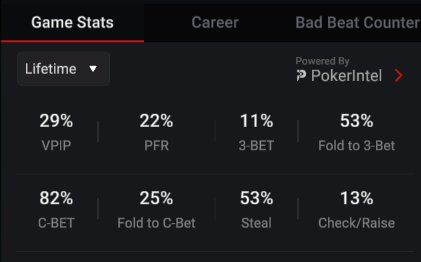
Player's Stats
These numbers help in close decisions.
Once you’ve played at least 50 hands against someone, you can start estimating ranges. Software like Flopzilla helps here. For example, if you see an 18% opening range, the program shows which hands that likely includes.
Ideally, memorize common opening and calling ranges before you play so you don’t get distracted during tournaments.
-
Taking Notes on Players
Get into the habit of marking players with notes.
Most players barely change their style over time, and you won’t remember them by nickname alone.
Example: you realize someone is a total calling station who spends two hours entering pots with garbage hands. Assign a specific color label for “calling station” and tag them.
The next time you encounter that player, you won’t need to spend two hours gathering information again.
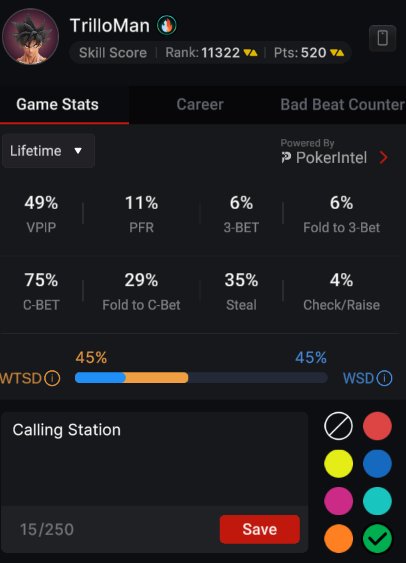
Marking the fish
-
Early Stage
The beginning of a tournament is the best time to take risks.
That doesn’t mean making insane calls with the third pair. But in borderline situations — for example, calling a flush draw getting roughly 2-to-1 pot odds — taking the gamble can be worth it because doubling early gives you a major advantage.
That’s exactly why we recommended a 150 buy-in bankroll. During early levels, if you bust, you can still rebuy with a playable stack.
An hour later, rebuying becomes much weaker and often isn’t worth it anymore. At that point, it’s usually better to simply register for another tournament.
-
Middle Stage
This is the stage where rebuying is mostly over, and you need to reassess your direction.
Yes, you chose a strategy before the tournament began, but reality may force adjustments.
Example:
You have 30 big blinds. That’s enough to reach ITM by playing carefully. But tournament chip leaders already hold 200–300 BB stacks.
Even if you double or triple up, catching them becomes extremely difficult.
In this situation, it may make sense to switch your objective from chasing top finishes to securing ITM. You can tighten up, folding marginal hands and even medium aces or small pocket pairs.
-
Bubble and ITM Play
The bubble is a double-edged sword.
On one hand, folding most hands allows you to reach the money fairly easily. Even if you’re near the bottom of the standings, someone impatient usually busts before you.
On the other hand, you can exploit players who desperately want to survive into ITM.
Example:
You have 30 BB, while your opponent has 15 BB. He min-raises.
His stack is big enough to survive into the money, but still much smaller than yours. Even if you lose, you’ll probably still cash.
Instead of folding Q-10, you can shove all-in because an ITM-focused player will fold around 90% of his hands against your pressure.
Once the bubble bursts and you reach the money, it’s time to take risks again.
Playing ultra-tight no longer makes sense because payouts increase slowly at first. Many opponents relax emotionally after cashing and begin playing looser.
That creates excellent opportunities to double up with decent holdings like suited K-10 or even pocket threes.
-
Final Table
If your tournament run goes well and you reach the final table, you need to reevaluate everything again.
Players often dramatically change styles at the final table because every pay jump suddenly matters much more.
Aggressive players may tighten up due to the pressure of serious money.
If you marked someone earlier as loose-aggressive, don’t blindly trust that read now — they may completely change gears.
Your own job is the opposite: don’t freeze up out of fear of losing money. Playing too tight at the final table is one of the fastest ways to lose.
The best approach is controlled aggression:
play aggressively, but mainly target stacks at least one-third smaller than yours.
Because effective stacks are usually medium or short at final tables, the value of a second chance becomes critical.
Example:
You have 18 BB on the button. The big blind has 10 BB. You raise KQ, he shoves, and you call. He shows A-10. You’re around 40% to win, but lose the hand.
Still, you survive with 8 BB left — enough for another all-in spot later, perhaps even with something mediocre like 8-7 suited, where you still have roughly 35% equity.
The probability of winning at least one of those two all-ins is actually higher than risking your entire tournament life once with A-K versus J-10 suited against a larger stack.
That’s why at final tables you should focus not only on card strength, but also on preserving opportunities for a second chance.
---------------------------------------------------------
These are the core strategic concepts. They don’t include specific hand analysis — that’s a topic for another article — but now you should at least understand how to think about tournament poker at the macro level.
And if you’re not quite ready to dive into serious tournament poker yet, you can always practice poker hands and enjoy the atmosphere in the Coins.Game live poker casino.
What's Your Reaction?