Omaha: Differences from Hold’em and Game Strategy
Omaha Hold’em is the second most popular poker game after Texas Hold’em. At first glance, it looks very similar, except that players receive four hole cards instead of two. However, that single change completely transforms the game. In this guide, we’ll explain exactly how Omaha differs from Hold’em and what strategies you should use to play it confidently.

Let’s agree right away that we’ll call the games simply Omaha and Hold’em, as most players do. Technically, their full names are Omaha Hold’em and Texas Hold’em, but that’s not very convenient.
Omaha Rules
The hand rankings in Omaha are exactly the same as in Hold’em, so Hold’em players do not need to relearn combinations. However, there is one special rule for building hands that makes Omaha a fundamentally different game.
Two Cards from Your Hand
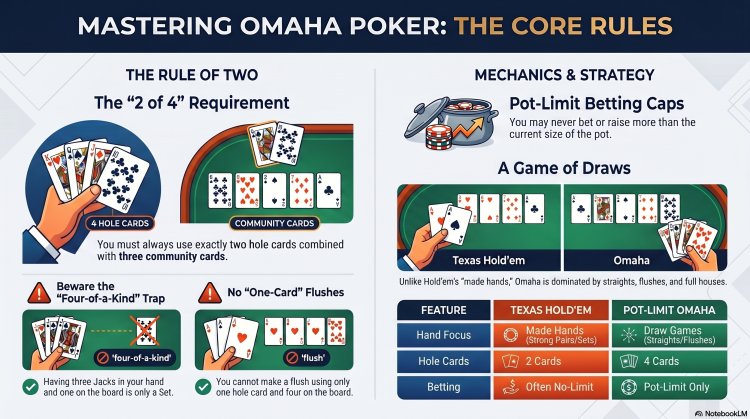
Out of your four hole cards, you must always use exactly two. Not “up to two” — exactly two.
That means you cannot make a five-card hand using four cards from the board.
Examples
Your hand: J♠ J♦ J♥ 8♥
Board: A♦ 2♥ J♣ 7♠ 4♠
You do not have quads. You only have a set of jacks.
Your hand: A♥ K♠ Q♥ 9♦
Board: 9♥ J♠ 6♠ A♠ 5♠
You do not have a flush.
To make a flush, one more of your hole cards would also need to be a spade.
Pot-Limit Structure
In most Omaha cash games and tournaments, the betting format is Pot-Limit Omaha (PLO), although this is not mandatory. Sometimes you can find Limit Omaha, No-Limit Omaha, or mixed formats such as pot-limit preflop and no-limit postflop.
This means you may bet or raise no more than the current size of the pot.
If the first player after the big blind raises preflop, the maximum raise is usually 3.5 BB. The next player may then raise by the size of the new pot: the current pot plus the call amount.
On the flop, if the pot is 9 BB, the maximum bet is also 9 BB.
This betting structure further emphasizes the importance of draws, which appear constantly because players hold four cards.
As a result, the main difference between Omaha and Hold’em is this:
- Hold’em is mostly a game of made hands (strong pairs, sets).
- Omaha is mostly a draw game (straights, flushes, and full houses dominate).
Game Strategy
Most Omaha players use one of two approaches: aggressive or passive. There are fewer shades in between than in Hold’em.
If you see a player with:
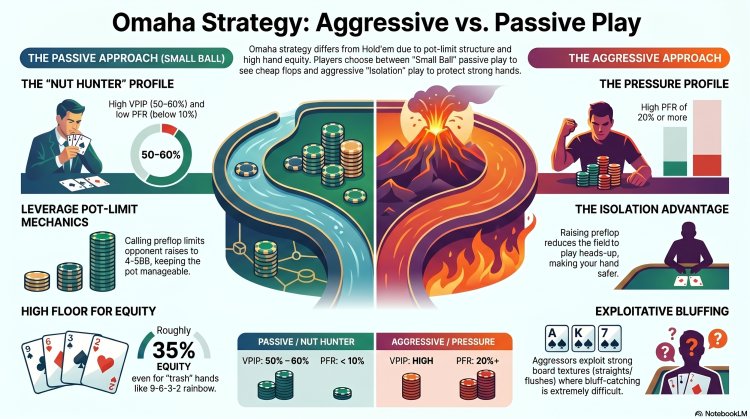
- VPIP: around 50–60%
- PFR: below 10%
then you are probably dealing with someone who wants to see as many flops as possible while waiting for the nuts.
If a player has a high PFR (20% or more), they likely prefer constant pressure and aggression.
Why does this work?
Because in Omaha it is almost impossible to put an opponent on a precise hand. A player may appear to be playing top pair on the flop, then accidentally complete a straight on the turn using two completely unrelated cards.
That makes bluff-catching extremely difficult. Potential Omaha hands are usually very strong — straights, flushes, full houses — so aggressive players exploit this by bluffing many boards.
Small Ball — Many Small Pots
This strategy does not always work. If the table is full of maniacs, you will fail with it. But often opponents are happy to see cheap flops.
The idea is simple:
With a decent hand, you enter the pot by calling rather than raising.
In Hold’em this is terrible, but in Omaha it works because of the pot-limit structure.
If you limp or call, the maximum raise against you preflop is limited. Since almost any four-card hand has reasonable equity, calling becomes profitable more often.
Example:
Even a trash hand like 9-6-3-2 rainbow still has around 35% equity against a random hand.
Aggressive Strategy
Aggressive Omaha means frequent preflop raises. However, unlike Hold’em, where raises require premium cards, Omaha raises often make more sense with medium-strength connected hands.
The purpose is usually not to steal blinds, but to reduce the number of opponents and ideally play heads-up.
Example:
You hold: 10♣ 9♣ 7♦ 7♠
If several players enter the pot and you flop a set or a flush, there is still a serious danger that somebody else has a higher set or higher flush.
But if you isolate a single opponent, your hand becomes much safer.
Which Hands to Play in Omaha
The strongest Omaha hands are usually:
- suited connectors
- double-suited hands
- suited aces
Pocket aces are still technically the strongest preflop hand, but they are difficult to play.
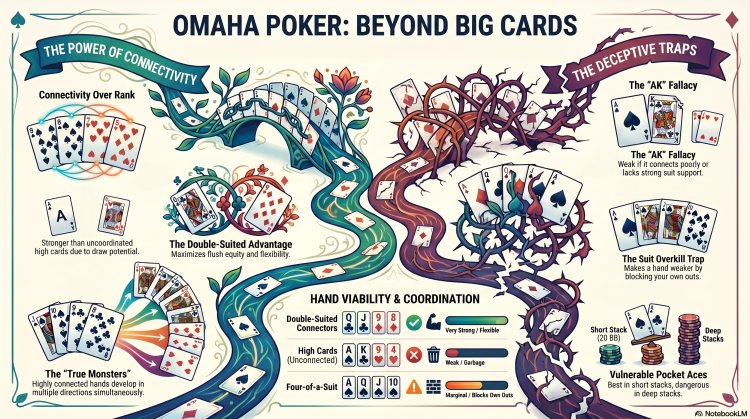
Hands like Q♣ J♣ 9♦ 8♦ are often easier and more flexible.
Example flop: 8♣ 9♥ 6♣
Now you have:
- two pair
- straight draw
- flush draw
Your outs include:
- all clubs
- three sevens
- three tens
- two nines
- two eights
That gives you roughly 19 outs, which is enormous equity even against a flopped set.
Big Cards Are Different in Omaha
Example of a Bad Hand: A♠ K♣ 9♥ 4♥
This is basically garbage.
AK is a premium Hold’em hand, but in Omaha it is weak because:
- it connects poorly
- straight potential is limited
- the suited 9♥ 4♥ is not strong enough
A weak flush is dangerous in Omaha because it is often dominated.
Example of a Strong Hand: 9♠ 8♠ 7♥ 5♥
This hand is much stronger despite the lower ranks.
Why?
- connected cards
- double-suited
- strong draw potential
On a flop like:
8♣ 7♠ 4♠
you could already have:
- top two pair
- flush draw
- gutshot
That is an excellent Omaha situation.
Pocket Pairs
Most pocket pairs are played mainly for sets.
Example: K♥ K♠ 9♣ 4♦
No connectivity. No suits. If you shove this hand all-in preflop, you will often be close to a coin flip at best.
Even pocket aces should be played carefully in deep stacks. Aces work best in shorter stacks (around 20 BB), where you can pressure opponents before they realize their draw equity.
At 50 BB or deeper, aces become far more vulnerable.
Strong Drawing Hands
These are the true monsters of Omaha.
Examples:
-
J♠ 10♠ 9♣ 8♣
-
J♣ 10♣ 8♦ 7♦
These hands can develop in many directions simultaneously. Hands with multiple gaps become weaker and require caution.
Three- and Four-Suited Hands
Hands with three cards of the same suit are already somewhat marginal.
Example: A♠ K♠ Q♠ 7♦
It looks powerful, but:
- the third spade removes one flush out
- the 7♦ contributes almost nothing
You are effectively playing a three-card hand while opponents still have four useful cards.
A four-suited hand is usually garbage.
Example: A♠ Q♠ J♠ 10♠
You may still play it, but mostly hoping for a rainbow flop.
How to Play the Flop
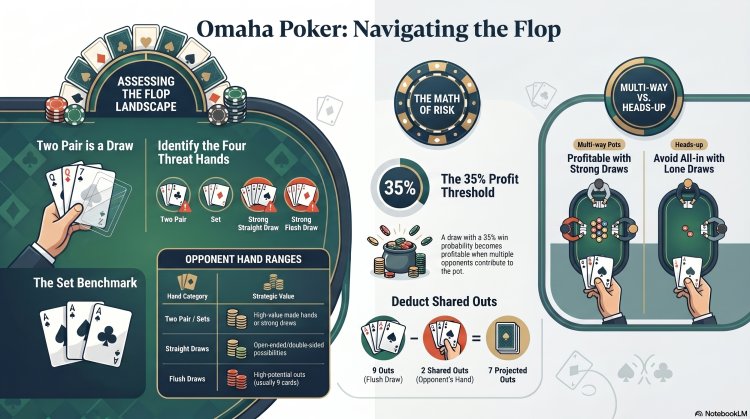
Most important Omaha action happens on the flop. Since strong hands dominate, you will usually have some kind of draw. Even two pair is often only a temporary hand.
After seeing the flop, start counting outs immediately.
Ask yourself:
- How many cards improve me?
- Could opponents share my draw?
- Am I drawing to the nuts?
Example:
If you hold a flush draw but suspect another player also has one, your effective outs decrease from 9 to 7.
The Most Important Rule for Beginners
If you are new to Omaha, remember this:
People almost never bluff big on the river. Of course, bluffs do happen sometimes. But far less often than in Hold’em. If an opponent makes a huge river bet and you only hold one or two pair, folding is usually correct.
Why?
Because Omaha offers many semi-bluff opportunities on the flop and turn. Most aggressive players apply pressure earlier in the hand while they still have drawing equity.
River bluffs are expensive and risky in Omaha, so most players avoid them.
What's Your Reaction?