How to Play the Most Popular Poker Games
Poker comes in many different variants, and over time some become more popular while others fade into obscurity. On this page, we’ll briefly cover the key games in the history of poker and take a closer look at the rules of the most popular modern variants.

History
Originally, there was five-card draw poker: each player is dealt five cards and can exchange any number of them once to form the best possible hand. Back then, you could only enter the pot if your starting hand contained at least a pair of Jacks. This game is the predecessor of modern casino video poker.

Then came Stud poker, first five-card and later seven-card, which became the standard. Players receive three cards, one of which is face up. Then, on each subsequent street, they are dealt additional face-up cards, followed by a betting round. Betting is limited. The seventh card is dealt face down, and there are no community cards.
Stud eventually became the precursor to Texas Hold’em, the most popular poker variant today. In the past, players often played limit Texas Hold’em — a legacy of Stud. However, they later realized it was somewhat less exciting and shifted to the no-limit version, which remains the dominant format worldwide.
No-Limit Texas Hold’em
The rules are relatively simple, but the game itself is difficult to master. Each player is dealt two hole cards face down, followed by a betting round. At this stage, two or more players can already go all-in — putting all their chips into the pot — even on the very first action.
Next, the first three community cards (the flop) are dealt. Players can use any combination of their hole cards and the board to make the best five-card hand. If no one is all-in, another betting round follows. Then comes the fourth card (the turn), followed by another betting round. Finally, the fifth card (the river) is dealt, followed by the last betting round. Players then reveal their hands, and the best combination wins the pot. The pot can also be split if hands are identical.

Why is the game so complex? Because of the vast number of possibilities, shared community cards, and intricate betting dynamics. For comparison, five-card draw had only two betting rounds — before and after the draw — and decisions were largely based on guesswork, as the only information available was how many cards your opponent exchanged.
Stud has more complex mechanics, but its fixed betting structure makes decisions easier, as players usually don’t risk losing their entire stack in a single hand.
In Texas Hold’em, however, you can lose your entire stack in one hand, making mistakes extremely costly. At the same time, mistakes are easy to make due to the sheer amount of information: community cards, opponent actions on every street (preflop, flop, turn, river), and your own hand.
On top of that, the game constantly evolves. Almost every year brings a new “meta.” In the past, standard raises were 3 big blinds; now it’s often 2. Continuation bets used to be large and rare; today they are small and frequent. This constant evolution makes Texas Hold’em challenging both to learn and to stay proficient in.
In one of our upcoming articles, we’ll take a deeper dive into the strategies required to succeed in this game. For now, let’s move on to the second most popular poker variant — Omaha.
Omaha Hold’em
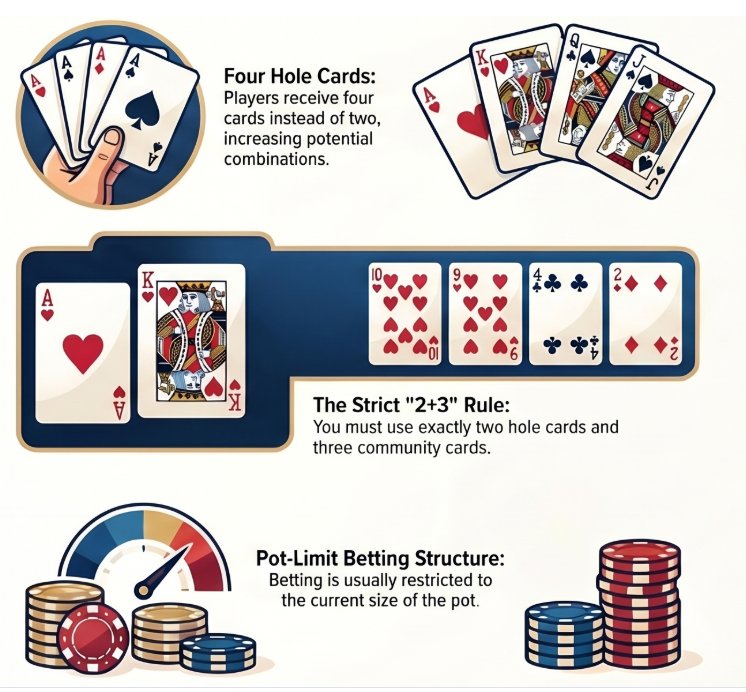
Omaha uses the same structure as Texas Hold’em: preflop, flop, turn, river, with a betting round after each street. The key differences are:
-
Omaha is usually played as pot-limit, meaning the maximum bet is the size of the pot (though mixed formats also exist).
-
You must use exactly two hole cards and three community cards to make your hand. In Texas Hold’em, you can use one, both, or none of your hole cards.
Strategically, Omaha is more mathematical due to the greater number of possible combinations. It is a drawing game, meaning players often chase straights and flushes rather than rely on made hands.
Hands like top pair or even two pair are relatively weak in Omaha and often get beaten. To win consistently, you typically need strong combinations like straights, flushes, or full houses. You will also often have multiple draws at once, so calculating odds becomes crucial.
Beginners often think Omaha is easy because they’re dealt more cards, but starting hand selection is just as important — if not more so — than in Texas Hold’em. Pots are also more likely to involve multiple players.
We’ll cover Omaha strategy in more detail in a future article.
Omaha 5 and Omaha 6
These are newer variations where players receive five or six hole cards instead of four. These versions are even more draw-heavy, and you’ll almost always need the nuts (the best possible hand) to win.
For example, if you have a Queen-high flush against multiple opponents, it’s very likely that someone has a King- or Ace-high flush.
Starting hands like a pair of Aces or Kings lose much of their value unless they are suited and connected. These are extremely high-variance games that require strong mathematical skills.
Short Deck (6+)
A relatively new and rapidly growing variant of Texas Hold’em. All 2s, 3s, 4s, and 5s are removed from the deck.
There is a new rule – a flush beats a full house, since it’s harder to make with a shorter deck.
Overall, the reduced deck makes the game more similar to Omaha: it becomes highly draw-oriented, and strong hands are harder to hold up. This is one of the most volatile poker variants.
Even if you dominate your opponent (e.g., Ace-King vs. Ace-Queen), they may still have close to 35% equity.

Short Deck is ideal for players who find folding hand after hand in Texas Hold’em too slow, and for those who enjoy action, risk, and bluffing. The pace is extremely fast, with frequent all-ins and large pots.
We’ll also cover Short Deck strategy and math in detail soon.
Chinese Poker
This is a completely different type of poker. While it uses standard poker hand rankings, the gameplay is entirely different.
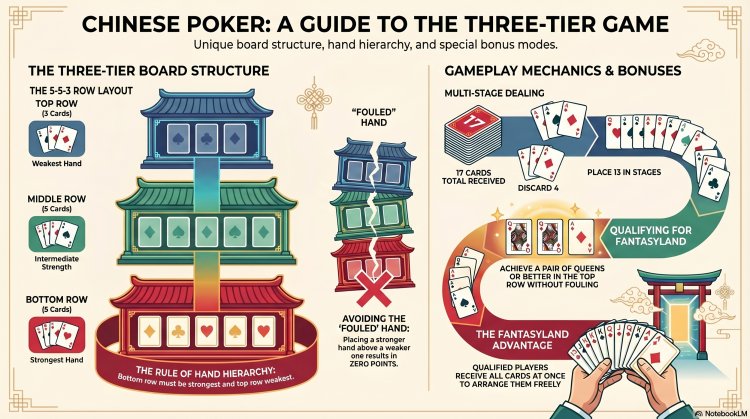
Each player receives 17 cards per round, 13 of which must be arranged on a special board consisting of three rows:
-
Bottom row: 5 cards
-
Middle row: 5 cards
-
Top row: 3 cards
You must form three poker hands, with the strongest on the bottom and the weakest on top. All cards are placed face up. Cards are dealt in stages: each time, you place two cards and discard one.
Once all hands are set, players compare rows and score points (“royalties” or “units”). If your hand structure is invalid (e.g., a stronger hand placed above a weaker one), it’s considered a fouled hand, and you score zero points while your opponent gains a significant advantage.
There is also a special mode called Fantasyland. It is activated if you make a pair of Queens or better in the top row without fouling your hand. In Fantasyland, you receive all your cards at once and can arrange them freely — this is a huge advantage. Because of this, players often take risks to qualify for it.
There is also a version with jokers, which can act as wild cards.
These are the most popular poker variants played today. Of course, there are many others — Razz, 2-7 Lowball, HORSE, 8-Game, Badugi, and more — but they are more niche.
If you’re interested in any of the games described above, stay tuned for upcoming posts where we’ll explain how to play and win in detail.
What's Your Reaction?